DOE, ground truth, performance metrics, DFM, test fixtures, unit cost and certification path.
DECISION 05 · PILOT02:35–03:0006
Risk, resources & 90 days
Owners, gates, kill criteria, budget and one undeniable customer loop.
DECISION 06 · FUND
ROOM STANDARDEvery assertion resolves to a measurement, artifact, owner, test, or explicit assumption.Every open issue receives a closure criterion.Every feature must earn power, BOM, latency, security and workflow cost.
03
SYSTEM ARCHITECTURE
One signal path. Every claim traceable.
The architecture is intentionally narrow: sense an operational condition, preserve context, request human judgment, and produce evidence an owner can export.
01REV C
Sense
Pipe temperature · vibration · 38–42 kHz acoustic energy · ambient T/RH · optional pressure
→
02FIRMWARE
Gate
Run-state prevents idle acoustic noise from being interpreted as leak-risk evidence.
→
03CALIBRATE
Screen
Bounded 0–1 heuristic. A watch state prompts technician review; it does not declare a leak.
→
04PROTOTYPE
Bind
Timestamped reading + asset identity + prior hash become one append-only evidence event.
Screen first. Diagnose second. Escalate with evidence.
Rev C uses an intentionally conservative heuristic. The model is a calibration target, not a finished scientific claim.
RUN-STATE GATE
running = RMSvibration ≥ 0.05 g
If the compressor is not running, the current firmware returns zero acoustic leak-risk.
REV C SCREEN
risk = clamp(Eultra, 0, 1)
Normalized ultrasonic energy is interpreted only inside the run-state gate.
WATCH STATE
running ∧ risk ≥ 0.70
WATCH requests review. It is not a leak diagnosis, alarm certification or automatic compliance determination.
01
Assumption
Ultrasonic band energy contains a useful screening signal after mechanical and environmental noise controls.
02
Required test
Collect labeled baseline, known-condition and nuisance-condition data across asset classes and operating modes.
03
Promotion gate
Freeze thresholds only after sensitivity, specificity, false-positive rate and repeatability are measured.
ACOUSTIC PATH
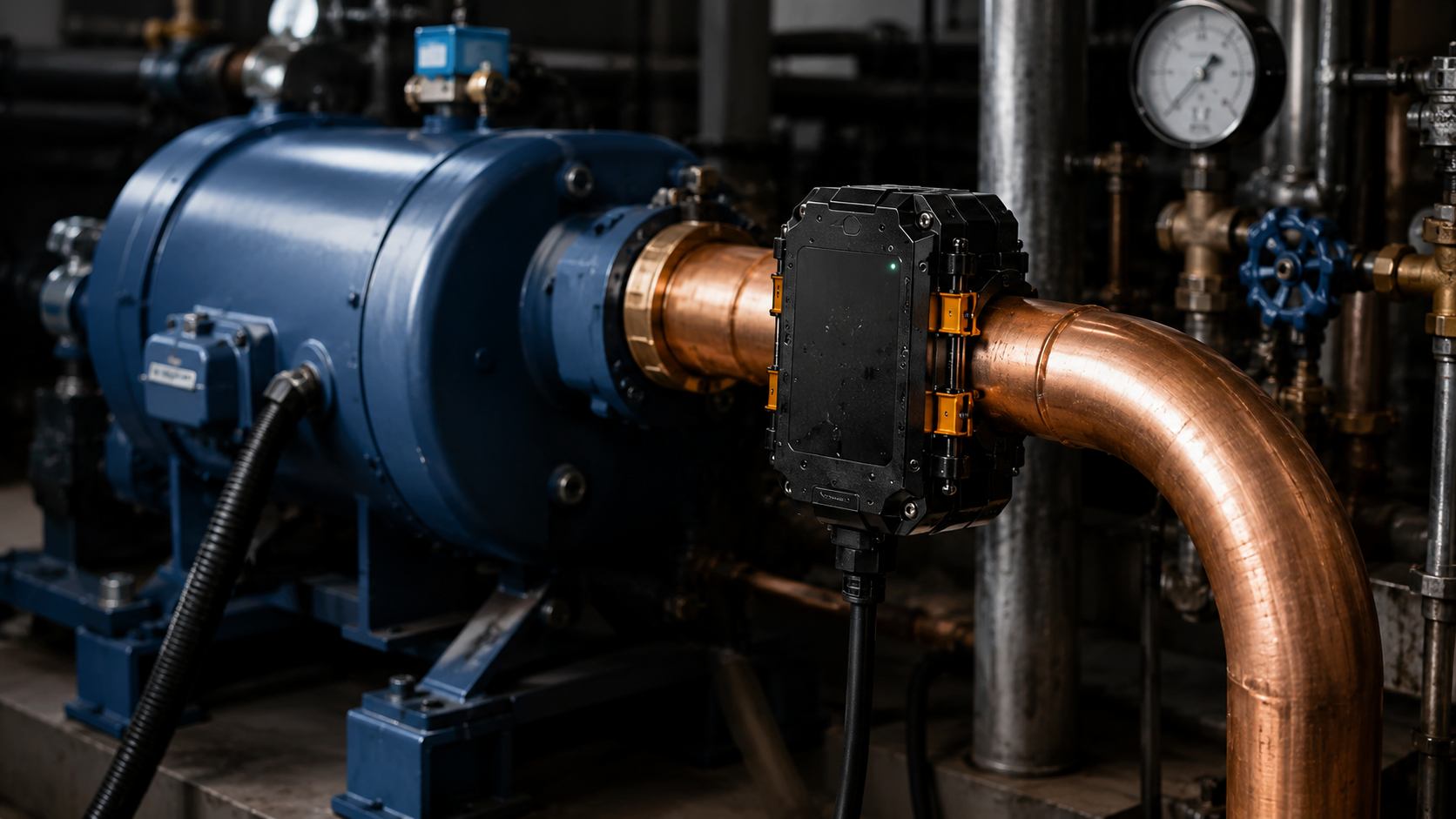
Source → pipe wall → silicone pad → microphone AFE
Coupling loss, pipe diameter, wall thickness, refrigerant state, background machinery and clamp preload all alter transfer response. Rev D requires a characterized transfer function and installation repeatability specification.
Temperature and pressure are contextual—not direct charge measurements.
Raw pressure cannot be interpreted without refrigerant identity, line side, operating state, saturation relationship, superheat/subcooling context and ambient/load conditions.
T_sat = f(P, refrigerant)FEATURE PIPELINE
Window → detrend → band energy → baseline delta → persistence
The production candidate should retain raw windows for validation, compute device-side features for bandwidth, and version every feature extractor so historical decisions remain reproducible.
Eband = Σ |FFT(x)[f₁:f₂]|²
06
EMBEDDED SYSTEMS / FIRMWARE
From GPIO to defensible event—every state explicit.
The current scaffold proves the pipeline shape. The production firmware needs deterministic acquisition, health telemetry, secure identity, offline resilience and remotely verifiable versions.
DEVICE STATE MACHINE
STATE 02
Baseline is a controlled procedure
✓ Confirm placement, line identity and pipe diameter
The proprietary software begins with an immutable semantic model.
Signals, interpretations, actions and regulatory conclusions must be separate objects. Otherwise the system cannot be audited, recalculated or trusted.
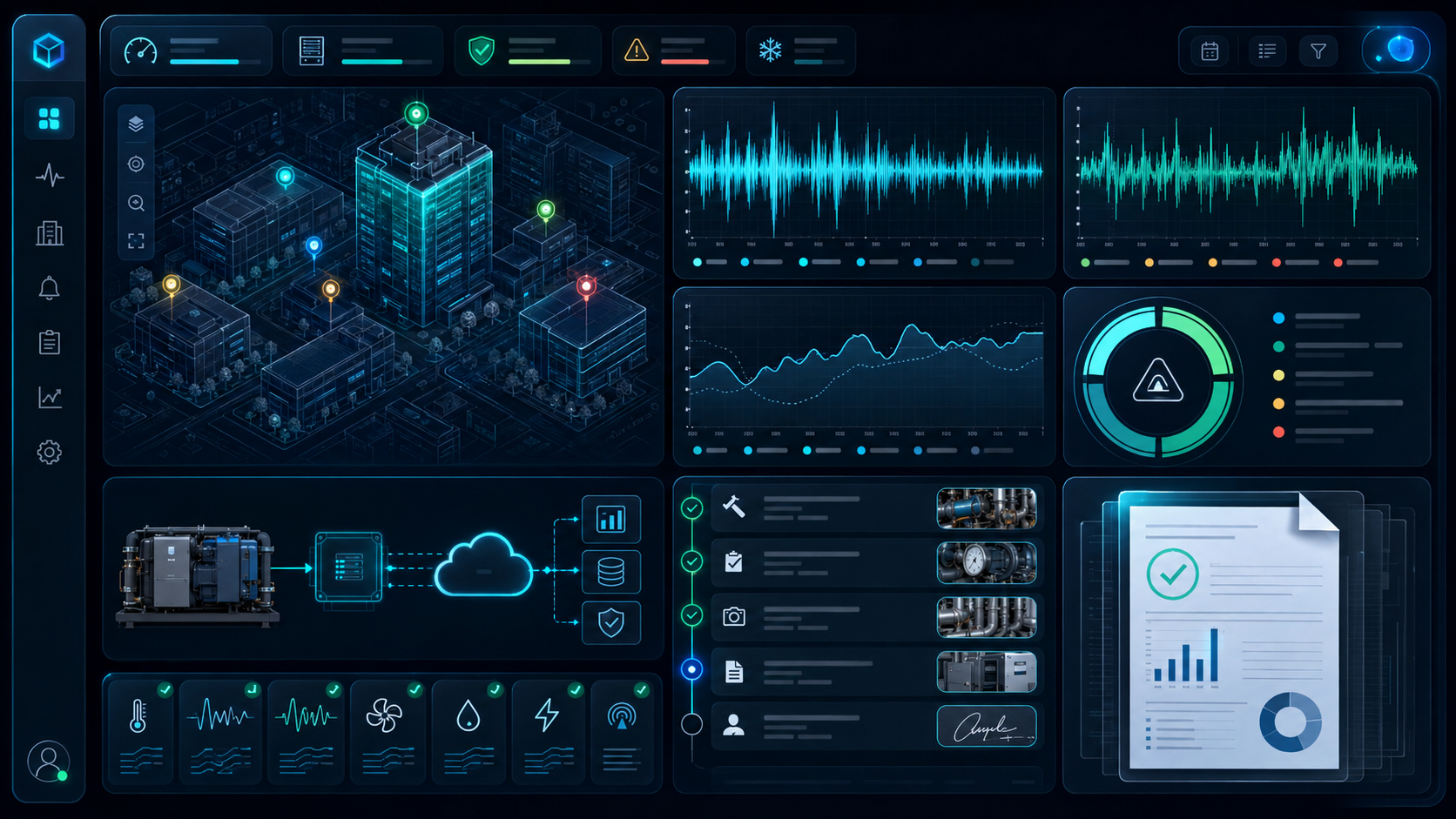
Illustrative interface data. Current code prints FNV-linked records to serial; flash/SD persistence, cryptographic signing and secure MQTT publishing remain implementation work.
01Asset-bound timestamp
02Raw channel values
03Derived screen state
04Technician disposition
05Exportable owner record
09
COMPLIANCE-RULE ENGINE
Rules change. The evidence should not disappear with them.
RefrigDNA separates immutable source records from versioned rule interpretation, allowing an owner to reconstruct why a task, deadline or packet was produced.
INPUT
Asset profile
Jurisdiction · refrigerant · charge · equipment class · owner policy · service history
VERSIONED LOGIC
Rule evaluation
Applicability → threshold → event window → required action → due date → required evidence
OUTPUT
Actionable record
Alert · work order · technician attestation · repair evidence · owner report · audit export
EXAMPLE / TRACE VIEWVERIFY BEFORE PRODUCTION
Why did this asset enter review?
Signal
Persistent WATCH condition during run-state
Rule set
Customer policy / v0.3
Evaluation
3 qualified events inside 24 hours
Action
Technician review requested
Evidence
5 readings + asset profile + event hashes
Regulatory applicability and deadlines must be validated against current EPA, CARB and jurisdiction-specific requirements before deployment.
INTERACTIVE RULE PROVENANCE TRACE
Select each stage to prove how an outcome can be reproduced.
TRACE STAGE 1
Typed facts, never free-text guesses
Asset snapshot includes refrigerant identity, charge, equipment class, jurisdiction, event history and confidence/source for each fact.
SELECTED RESPONSIBILITYField truth creation: authenticated install, channel health, diagnostic evidence and technician disposition.MOBILE / TECH APP
WORKFLOW STATE CONTRACT0OBSERVED1QUALIFIED2REVIEW_REQUESTED3TECH_ACCEPTED4DIAGNOSED5REPAIR_PLANNED6REPAIRED7VERIFIED8CLOSED9REOPENED
11
LIVE VALIDATION WORKBENCH
Move the inputs. Expose the claim.
This simulator makes the current Rev C decision boundary visible. It is an engineering discussion tool—not field performance evidence.
RUN-STATEQUALIFIEDSCREEN RESULTWATCH
SCREEN FUNCTION / CURRENT SCAFFOLDNOT CALIBRATED
RISK SCORE0.74
if vibration_rms < 0.05g:
    risk = 0.00
else:
    risk = clamp(ultrasonic_energy, 0, 1)
state = WATCH if risk >= 0.70 else NORMAL
FACTORLEVELS / STRATARESPONSEACCEPTANCE ANALYSIS
DOE FACTOR 1
Prevent a model that only works on one machine
Block by compressor technology, refrigerant family, nominal charge, line side and asset age. Report confidence intervals within strata—not only pooled accuracy.
SensitivityTP / (TP + FN)
SpecificityTN / (TN + FP)
PrecisionTP / (TP + FP)
FARfalse watches / asset-day
Latencycondition → qualified event
Repeatabilityinstaller × asset variance
12
DFM / SUPPLY CHAIN / UNIT ECONOMICS
A prototype becomes a product when every part earns its place.
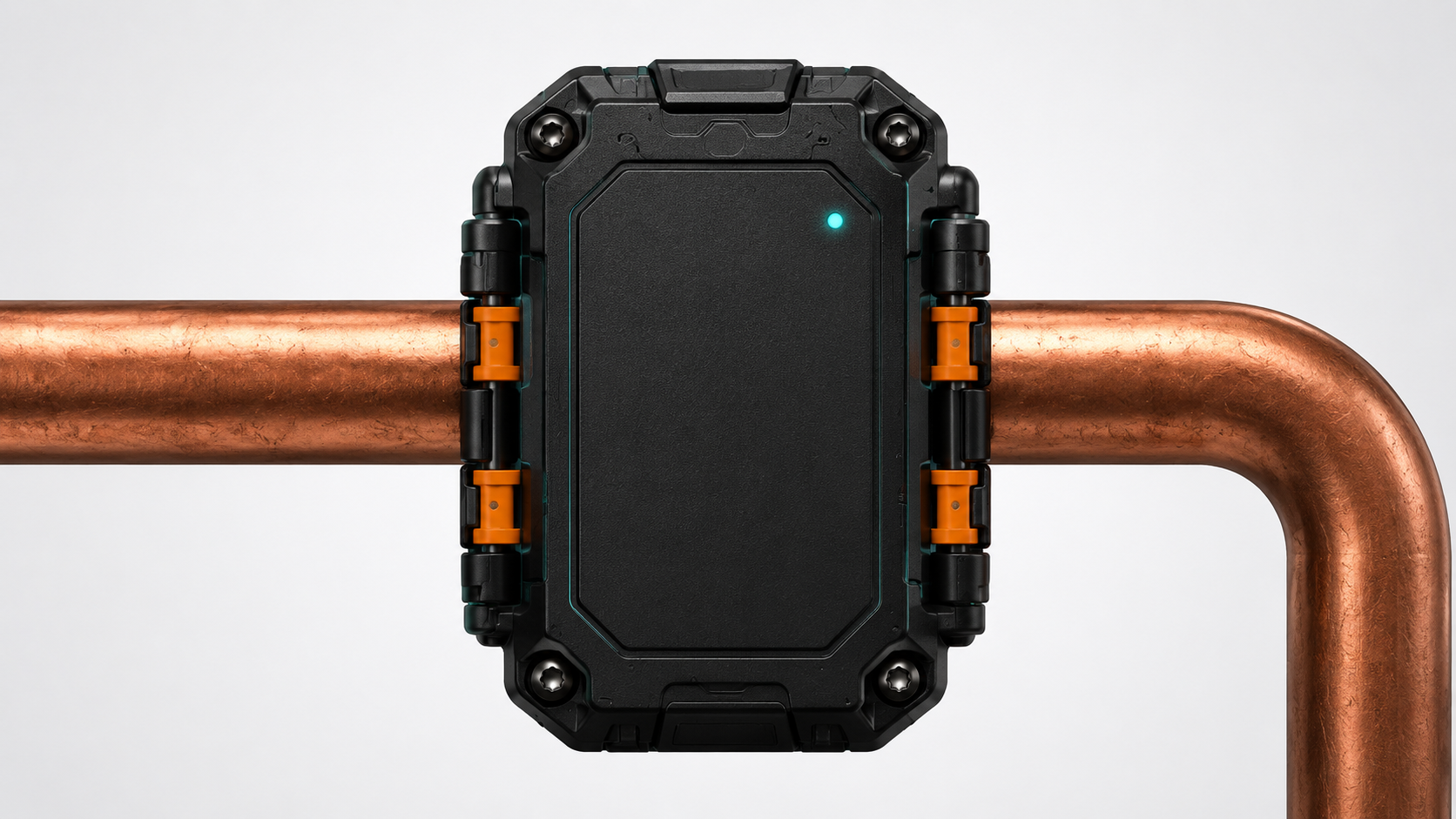
Rev C is a parametric, printable fit-check platform. Rev D must close electrical, mechanical, test, assembly and certification architecture together.
Compute + radioESP32-S3 module$8–15Single module; provision per-device identityCore sensingTMP117 + ADXL355 + SHT4x$55–95ADXL355 dominates cost; validate lower-cost alternativeAcoustic AFEmic + filter + ADC path$8–25Custom AFE required; characterize 38–42 kHz responsePressure tier0–600 psi transducer + adapter$25–80Optional service tier; safety and field connection costEnclosure + clampFDM prototype → molded/machined$18–65Pipe adapters, preload control, ingress and thermal designPower + interconnectbuck/LDO · protection · connectors$12–30Industrial supply range and reverse/transient protectionAssembly + testfixture · calibration · serialization$20–55Design-for-test points and automated end-of-line record
INTERACTIVE EARLY COST ENVELOPE$234–366
Illustrative sensitivity model—not a supplier quote. Move volume to expose assumptions and required sourcing work.
Dominant cost risk
engineering modules + manual assembly/test
DFM decision
retain modular pilot architecture
Commercial test
value per avoided manual inspection / completed evidence packet
P0AFE saturates in plant noiseMissed/false screengain strategy + clipping telemetrynuisance matrix + dynamic range test
P1Clock or sequence discontinuityEvidence chronology compromisedtrusted-time status + monotonic counterpower-cycle/offline/fault injection
P1Credential extractionFleet impersonationsecure element + per-device keysthreat model + penetration test
P1OTA failureDevice unavailable / inconsistent fleetA/B image + signed manifest + rollbackpower-loss update test
13
PROTOTYPE / MVP READINESS
The difference between designed, demonstrated and validated.
Technical credibility comes from making readiness legible. This is the current evidence boundary.
FILTER EVIDENCE BOUNDARY
Exists now
08 ITEMS
✓Parametric OpenSCAD clamp body + jaw
✓FreeCAD STL-export macro
✓Rev C mechanical envelope and pipe range
✓Component-level BOM and pinout/net specification
✓ESP32-S3 firmware scaffold
✓Run-state-gated screen logic
✓Hash-linked serial evidence record
✓Passport, dashboard and audit UX prototypes
Specified / ready to build
06 ITEMS
✓Sensor module selection and channel map
✓USB-C / DC power architecture
✓Wi-Fi/BLE and MQTT/TLS target
✓QR/NFC asset identity
✓FDM fit-check recipe
✓Pilot kit and installation workflow
Must be proven
08 ITEMS
✓Routed PCB and electrical bring-up
✓Real driver integration and calibrated ADC
✓Battery life under duty cycle
✓Environmental and mechanical durability
✓Secure persistent event storage
✓Labeled validation dataset
✓Sensitivity / specificity / repeatability
✓Applicable certifications and production enclosure
INSTALLATION CONCEPT
Clamp. Bind. Baseline. Verify.
Confirm pipe size and safe placement.
Install silicone interface and clamp without penetrating the line.
Scan QR/NFC to bind asset identity and technician.
Capture commissioning baseline across operating states.
Verify telemetry, time, channel health and owner export.
FIELD METHOD REQUIRES PILOT VALIDATION
14
CYBERSECURITY · DATA · ENGINEERING RISK
Known unknowns, converted into controlled work.
No security theater. No certification theater. Each open risk has an explicit control and closure test.
RISKWHY IT MATTERSCONTROL / CLOSURE TEST
01Signal discriminationPlant rooms are acoustically and mechanically noisy.Labeled nuisance matrix; baseline normalization; cross-signal persistence; blinded test set.
02Sensor couplingClamp force, pipe size and pad condition alter readings.Installation torque/fit method; reference coupon; repeatability test across installers.
03Evidence integrityFNV chaining is tamper-evident scaffolding, not production cryptography.Device identity, secure element, signed events, trusted time and verification service.
04Transport securityCredentials and telemetry cross customer networks.Per-device credentials, TLS, rotation, least privilege, offline queue and revocation test.
05Tenant/data ownershipOperational records may be commercially sensitive.Customer ownership terms, tenant isolation, RBAC, audit logs, retention/export/deletion controls.
06Regulatory interpretationRules and applicability can change.Versioned sources, effective dates, legal/technical review and reproducible evaluation trace.
07A2L / hazardous locationDevice placement and refrigerant class affect safety requirements.Installation envelope, ignition-source assessment and certification pathway before production use.
INTERACTIVE SECURITY + DATA-OWNERSHIP THREAT MODEL
THREAT DOMAIN 1
A counterfeit or cloned node submits trusted-looking events
Control
Per-device asymmetric identity in secure element; claim and revocation lifecycle
Verification
clone/replay/revocation test
Data right
Device identity belongs to fleet trust domain
15
DEVELOPMENT ROADMAP
Ninety days to one undeniable loop.
The objective is not more screens. It is traceable evidence that the device, workflow and customer value survive contact with a real asset.
DAY 0–30
Instrument
Freeze pilot claim and test protocol. Print clamp variants. Complete bench wiring, drivers, channel-health checks, secure local storage and raw-data export.
GATERepeatable readings on a controlled rigDAY 31–60
Calibrate
Capture baseline, seeded/known-condition and nuisance data. Label with refrigeration technician review. Quantify false positives and revise installation control.
Run one customer pilot from installation through owner packet. Measure alert usefulness, technician time, documentation completion and willingness to pay.
GATEOne customer loop with signed evidence
TECHNICAL ACCEPTANCE THESIS
RefrigDNA becomes fundable when a real customer can point to one asset and say: “This record helped us see the condition, route the work, and prove what we did.”
16
REVIEWER Q&A MODE
Interrogate the claim before the room does.
The hardest technical questions are part of the product—not hidden in an appendix.
ANSWER / 01
Does RefrigDNA detect refrigerant leaks?
Rev C is an evidence and leak-risk screening system—not a certified automatic leak detector. It combines contextual signals to identify a condition worth technician review. The product claim expands only after calibration and applicable certification.
REVIEW STANDARDDirect answerClaim boundaryEvidence gapClosure test
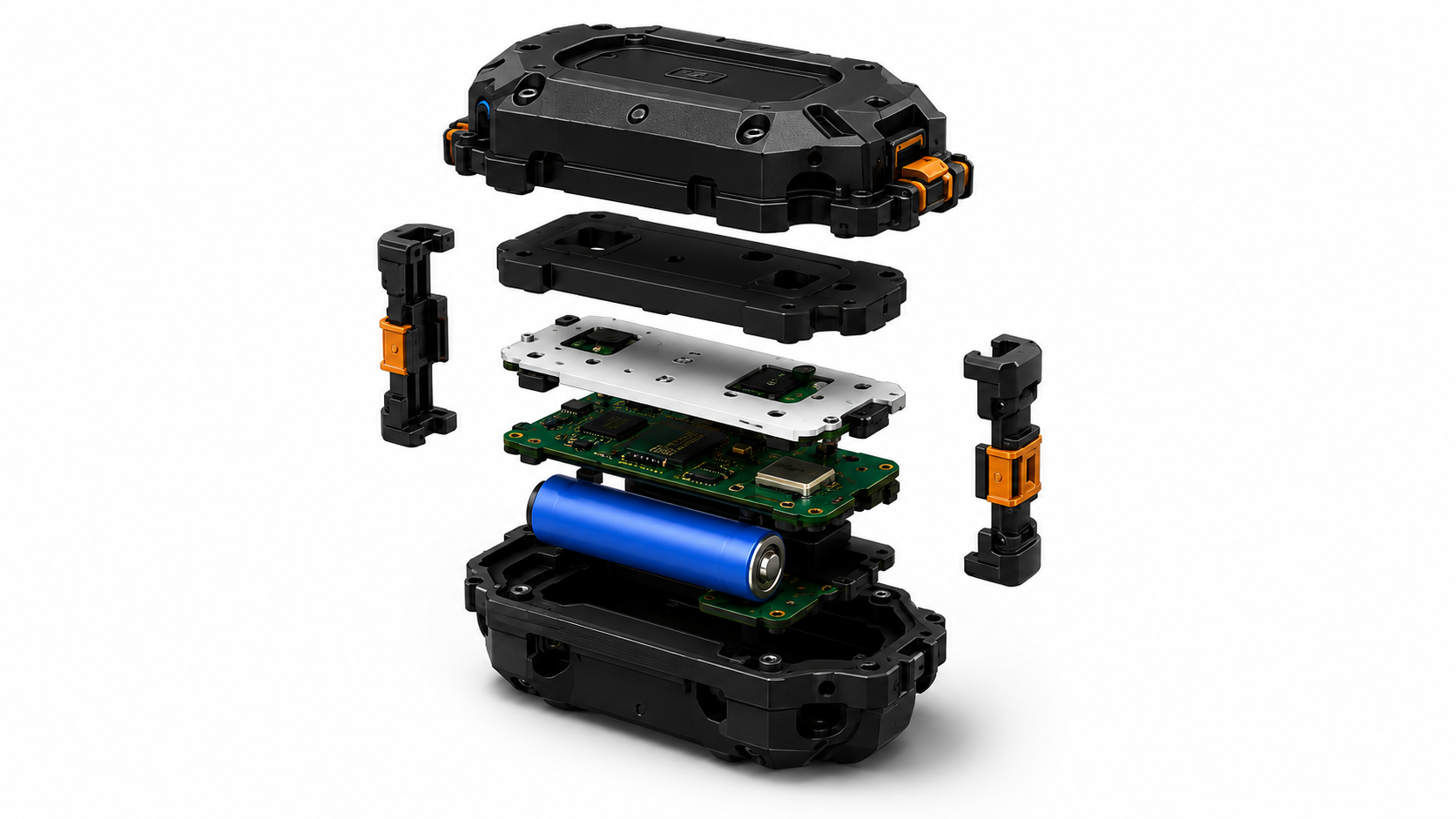 EXPLODED CONCEPT · NOT MANUFACTURING CAD